More people want to rent, and fewer homes are available. On 5 November the Bank of England raised Bank Rate to 4%, its first rise in this cycle (Bank of England). Meanwhile, surveyors report tenant demand growing at its fastest pace this year while landlord instructions keep falling (RICS).
For landlords who stay in the market, the result is strong demand, short voids and firm rents. Higher costs and new regulation, however, mean every property has to be let and managed well.
Why more people are renting
Higher living costs and dearer mortgages are keeping would-be buyers in rented homes for longer.
· Inflation is back up. CPI inflation reached 3.5% in the year to September 2026, up from 3.1% in August and the highest rate in almost a year. Rising petrol and diesel prices were the main cause (ONS).
· Borrowing costs are rising. The Bank of England raised Bank Rate by 0.25 percentage points to 4% on 5 November (Bank of England). Lenders had already been pricing in the rise.
· First-time buyers are staying put. Zoopla reports that higher mortgage rates have made buying harder for first-time buyers, so more of them keep renting (Mortgage Solutions). RICS made the same point in August: some prospective buyers are deciding that renting is the safer option for now (Property Reporter).
Surveyors are seeing this on the ground. In September a net balance of +23% of RICS members reported rising tenant demand. It was the third month in a row that demand growth had accelerated (RICS).
Why there are fewer homes to rent
The number of homes available to rent is shrinking as the cost of being a landlord goes up.
· Rental supply is falling again. Zoopla found that homes available to rent were down 3% year on year, the first fall in three years. Each listing now draws 5.3 enquiries, the highest level in nearly two years (Mortgage Solutions).
· Fewer landlords are listing. The RICS landlord instructions measure has stayed negative all year. In July its members said some landlords were shrinking their portfolios or leaving the sector (RICS).
· Refinancing costs more. Buy-to-let fixed rates rose sharply from March, and around 1,300 deals were withdrawn in a matter of weeks (Moneyfacts). In early November, Which? reported that buy-to-let rates were still rising (Which?). Many landlords who fixed for five years in 2021 are now coming off those deals.
· New rules add risk. The Renters’ Rights Act ended Section 21 evictions on 1 May 2026, and all tenancies became periodic (Property118). Commentators quoted by Zoopla say this has pushed some landlords to sell, while Zoopla points to mortgage costs as the bigger factor.
The North East: where landlords are winning
The North East is one of the strongest rental markets in Great Britain. It has the highest landlord yields, rent growth that leads the country, and some of the most affordable property to buy.
Rents are rising nearly four times as fast as house prices. Rents rose 3.8% in the year to September, while house prices rose 0.9% in the year to August (ONS).
Rightmove reports that northern regions continue to outperform on annual rent growth. The North East and North West both recorded annual rent increases of 4.1%, compared with 1.5% in the East Midlands and East of England.
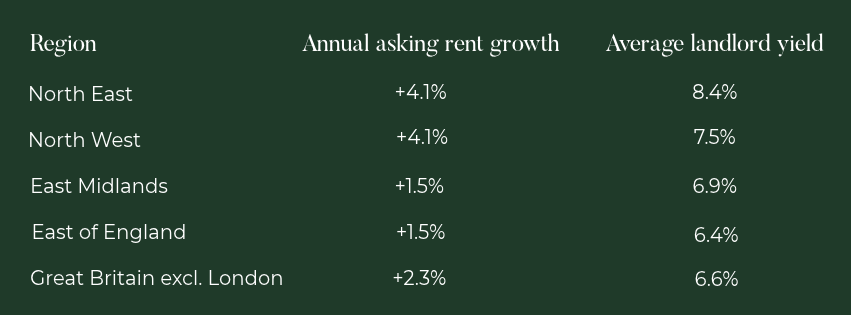
Source: Rightmove Rental Trends Tracker, Q2 2026.
The region also offers:
· Higher returns on lower outlay. With an average rent of £790 a month (ONS) and lower purchase prices, the North East yields 8.4%, nearly two percentage points above the average outside London.
· Capital growth as well as income. The North East had the fastest house price growth of any English region, 3.2% in the year to August (ONS).
· Momentum in affordable markets. Zoopla found rents in areas averaging £750 a month or less are rising about 5% a year, more than twice the national rate (Property Reporter).
What this means for landlords
There has rarely been more demand for a well-run rental home. Higher costs, though, mean landlords cannot afford to leave money on the table.
· Keep rents in line with the market. Under the Renters’ Rights Act, rent can be increased once a year with two months’ notice, backed by evidence of local market rents. Reviewing every tenancy on time makes a real difference to returns.
· Keep void periods short. With more than five enquiries per listing nationally, a well-presented, correctly priced home should let quickly. Each empty week costs more when mortgage payments are higher.
· Keep good tenants. Longer tenancies mean fewer changeover costs and steadier income.
· Check the numbers before you sell. If your fixed rate is ending, compare the return after a rent review and a remortgage with the proceeds from selling. In the North East, rising rents, the highest yields in Great Britain and strong house price growth often make holding the better choice.
Why a professional portfolio review matters
Many landlords coming off a five-year fix are making a big decision with out-of-date figures. A rent set in 2021 may now be well below market. A sale price may not reflect what the property earns. New regulation can turn a small compliance gap into a costly problem.
An independent review by an experienced, regulated letting agent gives you a clear picture before you commit:
· current market rent for each property, based on local evidence
· net yield after mortgage, fees and maintenance at today’s rates
· compliance under the Renters’ Rights Act, including notices, safety certificates and rent review dates
· the options side by side: hold, refinance, improve, or sell with or without a tenant in place
Selling a well-let North East property because the old numbers no longer add up could mean giving up one of the best yields in the country. A professional review costs nothing compared with that decision.
At Bradley Hall, our lettings teams across the North East currently have 2987 registered tenants waiting for homes. We let properties in an average of 10 days, and our average tenancy lasts 23 months. If your mortgage deal is coming to an end, or you are thinking about selling, contact your local Bradley Hall lettings office for a free rental review before you decide.
Contact your local office here: https://www.bradleyhall.co.uk/contact/
References 1. Office for National Statistics, Private rent and house prices, UK: October 2026, 21 October 2026. 2. Office for National Statistics, Consumer price inflation, UK: September 2026, 21 October 2026. 3. Bank of England, Monetary Policy Report, November 2026, 5 November 2026. 4. Rightmove, Rental Trends Tracker, Q2 2026, July 2026. 5. RICS, UK Residential Survey, September 2026. 6. RICS, UK Residential Survey, July 2026. 7. Property Reporter, Rental supply crunch deepens as RICS survey points to rising rents and landlord exodus (RICS August 2026 survey). 8. Mortgage Solutions, Rents rise as higher mortgage rates squeeze supply – Zoopla, 14 September 2026. 9. Property Reporter, Low-cost rental hotspots lead UK rent rises as supply squeeze persists: Zoopla, 11 June 2026. 10. Moneyfacts, Pain for landlords as buy-to-let borrowing costs soar, 30 March 2026. 11. Which?, What’s happening to buy-to-let mortgage rates? (rates as of 3 November 2026). 12. Property118, ‘Six-month fire sale’ looms as Renters’ Rights Act nears, 18 November 2025